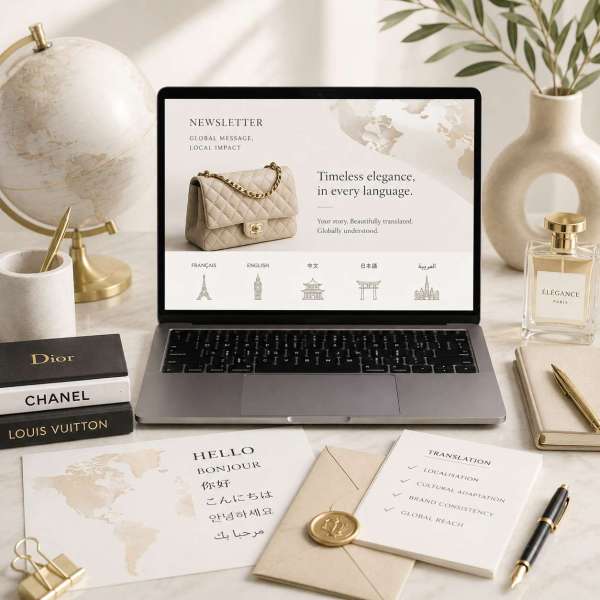
Translation of a multilingual newsletter for luxury brands
A newsletter is a regular touchpoint between a luxury brand and its customers. This format builds the relationship over time and, to work, it must ring true in every language in which it is received. For an international luxury brand present in several markets, the translation of a multilingual newsletter is therefore an operational as well as an editorial challenge. It shapes the quality of the customer relationship on a global scale and, as such, deserves a level of attention that communication teams can sometimes underestimate.
The multilingual newsletter: a format more complex than it seems
The newsletter holds a unique place in the brand communication ecosystem. Unlike a product description or a regulatory document, it blends several registers in a small space. In a few hundred words, it can combine product news and a brand editorial as well as a call to action. This information density makes its translation particularly delicate.
Between length constraints and cultural sensitivity
Translating a newsletter involves navigating length constraints and cultural constraints that a classic translation cannot resolve. A hook that works in English can fall flat in French if it is translated word for word. A familiar register, common in Japanese communication aimed at the general public, may seem out of place in a French version. This is why the translation of a multilingual newsletter requires translators capable not only of transposing a text, but of adapting it to the register and expectations of the target market.
The constraints of a newsletter’s email format
Technical constraints specific to the email format also need to be taken into account. Subject line length, mobile display limitations, and the handling of special characters across languages are just some of the parameters the translator has to factor in, in order to deliver content that’s ready to use as is, with no further tweaking needed from the CRM team. A translation that requires technical adjustments for each edition is not a complete translation.
Client case study: MUJI: a lasting collaboration
MUJI, a Japanese brand whose philosophy is based on simplicity and the rejection of the superfluous, deploys consistent communication internationally. Its newsletter, sent regularly to its French customer base, reflects this DNA: understated in form and precise in wording, it is carried by its sparse language.
OuiTranslate handles the translation of these newsletters mainly from English into French, and sometimes into a range of other languages, such asSpanish, Italian, German and Catalan. This is a long-term, ongoing collaboration, which allows the agency to build and gradually enrich a translation memory specific to the brand. Each approved term and each choice of register are integrated into our translation tool, so that terminological and stylistic consistency is built upon with each new delivery.
This type of regular collaboration clearly illustrates OuiTranslate’s approach: the agency does not treat each newsletter as an isolated assignment. Instead, it sees it as part of an ongoing brand communication, where consistency over time matters just as much as the quality of any single delivery.
The distinctive nature of the MUJI universe also calls for particular care when it comes to register. The brand avoids the classic advertising discourse that consists of boasting rather than describing. It seduces through precision and restraint rather than emphasis. A MUJI newsletter translated with an overly enthusiastic tone or inappropriate superlatives immediately betrays the brand’s DNA. This sensitivity to register, acquired over the course of multiple editions, is what makes a dedicated translator trained on the account so valuable.
The fundamental role of the translation memory
Translation memory is a tool that stores previously translated text segments and automatically suggests them when they reappear in a new document. For a recurring format like a newsletter, its contribution is twofold.
On one hand, it guarantees consistency: the same brand expressions and product names are always rendered in the same way, regardless of who is translating the text. On the other hand, it shortens delivery timeframes, because part of the text has already been translated and approved for previous editions.
For MUJI, whose editorial charter is based on a sparse language and precision of vocabulary, this tool is especially valuable. A single imprecise term or overly emphatic phrasing is enough to betray the brand’s world. The translation memory ensures that the decisions made previously are respected for each new delivery without having to be discussed again every time.
Operationally, the translation memory works in tandem with a brand glossary, which lists key terms and their approved translations, as well as usage conventions specific to the brand. For MUJI, this glossary covers the names of products and fabrics, as well as recurring phrases from the brand’s editorial universe. It constitutes a shared resource among all project stakeholders and guarantees continuity even in the event of translator turnover.
Challenges encountered when translating for multiple markets
To expand on the MUJI case, translating a multilingual newsletter raises questions that every international brand eventually encounters. In how many markets should communication be localised? Should the translation be based on a single source language or adapted from a pivot version? How can consistency of tone be maintained between a newsletter sent in French, English, German, and Spanish, when each language carries its own editorial conventions?
These questions have no universal answer. They depend on the brand’s positioning and the nature of its relationship with each market, as well as the frequency of its communications. A poorly translated newsletter, on the other hand, produces very concrete effects: a higher unsubscribe rate and a break in the relationship of trust built with the customer, leading to a downgrade in the customers’ perception of the brand in that market.
This is why brands that take their multilingual communication seriously do not treat translation as a technical step at the end of the communication chain. Instead, they integrate it into their process from the editorial design stage and take into account the length constraints and cultural differences that will determine the quality of each localised version.
This upstream integration also assumes a dialogue between the editorial teams and the translation agency. A subject line that is too long in English will be impossible to translate into German without exceeding display limits. A play on words in French will lose all its impact in Japanese if it wasn’t crafted with adaptation in mind. These challenges, which the agency identifies as soon as it receives the texts, are actually all opportunities for guidance and for closer collaboration, leading to a competitive advantage.
OuiTranslate translates multilingual newsletters
Our collaboration with MUJI illustrates what it means to be a partner in multilingual communication rather than a simple translation provider. OuiTranslate does not just receive a text and translate it. Our agency builds up its knowledge of the brand, its universe and its stylistic requirements, deepening it with each new assignment.
This approach calls for the right kind of set-up: a dedicated project manager on the account, and translators specialised in retail and brand communication, who work with our Phrase TMS platform to manage translation memories and glossaries centrally.
For brands whose newsletter is a strategic driver of customer relationships, this continuity is not just a bonus, it’s a condition of quality. A well-executed multilingual newsletter translation contributes directly to the consistency of the brand experience internationally, on the same level as editorial policy or product strategy.
Get in touch and let’s talk about the translation of your multilingual newsletter.